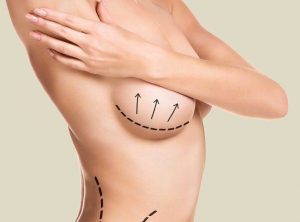
 Breast lift surgery is applied to those with structurally large and sagging breasts, whose breasts are sagged due to breastfeeding excessive weight loss and age. In addition, this procedure is performed for patients with a ”tubular breast deformity. It is also called goat breast. Breast lifts are usually performed in middle-aged patients who have given birth. However, structurally, if the breasts are too saggy, it can be applied to patients at young ages as well. Especially patients with tubular breast deformity can be operated at very early ages. As with all aesthetic procedures, breast lift surgeries are not applied to patients under 18 years of age unless they there is an unexpected condition.
Depending on how saggy the breasts are, breast lift operations may leave marks/scars such as:
Just around the nipple (periareolar mastopexy)
A vertical mark (vertical mastopexy) leading down and around the nipple
Vertical marks around the nipple (reverse T method)
If the nipple is not too sagged and the nipple is emptied after birth, only the breast prosthesis can be applied and the sagging can be corrected. In this case, there will be only a short incision under the breast, as in augmentation surgeries. The most common method for breast lift is vertical mastopexy. In this method, both marks are not much and aesthetic results are the best. In terms of persistence, vertical mastopexy is superior to other techniques. Breast lift surgery is performed under general anesthesia and in operating room. The operation lasts about 2 hours. The bigger the sagginess in the breasts, the longer the operation takes. There is no pain when the breast is lifted or when the breast reduction is applied. The first few days there will be mild pain and can be controlled by simple painkillers.
In patients with breast prosthesis with breast lift, if the prosthesis is placed under the muscle, a painful period is similar to that in breast augmentation. The first 3 days of this period is overcome with strong painkillers. Silicone prostheses are often placed on the muscles and small prostheses are usually used in the stitching process. Therefore, it can be said that there will be no more pain in prosthesis applications. The risk of not being able to provide milk in the patients who underwent breast lift surgery is even lower compared to the ones that had breast reduction surgery. It can be said that milking rates are not different from normal women. There may be temporary loss of feeling after breast lift. Permanent loss of feeling is not expected. A few months after surgery, the nipples regain their senses. The most common problems after lifting are bad scars/marks, the breasts not being lifted enough, asymmetries, nipples being too up or down than normal. These problems can be overcome by careful planning and careful surgical techniques. Prosthesis problems may occur in patients with breast prosthesis. The most important of these is capsular contracture. You can find detailed information about it under "Breast augmentation" section in our website.