
As their age progresses, people whose eyebrows got lower and people who had low eyebrows from birth are the candidates for eyebrow lifting and forehead lifting operations. Some patients only come with complaints of agglomeration of the upper eyelid, but the result of the examination may be related to the low eyebrows. In such patients, performing eyelid surgery without interfering with the eyebrows may cause an insufficient aesthetic result by shortening the eyebrow-eye distance further.
Many techniques have been defined for eyebrow removal. The method, location, patient's anatomical structure and the patient's wishes determine the method to be chosen.
Botox may be sufficient for patients who want to reduce the agglomeration of the eye and remove the brow edges slightly. In more advanced cases, thread lift can be applied. Eyebrows are hanged with threads sent through the hair, but long-term results from such procedures should not be expected. Temporal lift processes are a more permanent technique to remove the edges of the eyebrows and reduce the agglomerations of the eye. In this method, a short cut through the scalp is performed. Forehead stretching can be done on people with relaxed forehead skin, increased horizontal wrinkles on forehead and people whose eyebrow level is lowered and eyebrow-eye distance is narrowed.
During upper eyelid operations, the eyelid can be hung up through entering the incision. This method can be preferred especially in male patients with hair loss. Eyebrow hangers and temple stretching can be performed under local anesthesia. Forehead stretching is carried out in the operating room, under general anesthesia or under heavy sedatives (sedation). Eyebrow hangers last 30 minutes, temple stretching is 1 hour, forehead stretching takes 1-1.5 hours. It takes 1-2 hours depending on the operation to be performed. Hanging operations and temple stretching are painless. Patients can feel tension and pain after the forehead stretching but can be easily controlled with painkillers.
Hanging operations are often performed under surgery and patients can go home immediately. 3 hours after the temple and forehead stretching, the patient can eat and stand up. Usually 6 hours later, the patient is discharged from the hospital. The patient often has an elastic bandage on the forehead. The next day the bandage opens and the patient can bathe. Swelling and bruising are not expected after eyebrow straps and temple stretching. Temporary paralysis of the forehead after the forehead and temple stretching may occur. In rare cases, permanent eyebrow paralysis may occur. In the event of such a problem, Botox is applied to the other side of the face to create symmetry. Excessive lifting of the eyebrows and asymmetric problems may be encountered. The effect of the eyebrow hangers may take 1-2 years depending on the thickness of the skin and the level of the eyebrows. The results of the temple stretching are longer, but there is some reduction in the thick and heavy skin. The results of the forehead stretching are permanent.
Rejuvenation procedures of the lower face and neck are often performed as part of facial rejuvenation procedures. However, it can be performed alone in patients who have no serious problems in the upper and middle face area. People who have collapse at the edges of the jaw, lubricated on the neck and have sagging on the neck skin are suitable candidates for these procedures. It is usually performed over 40 years of age.
The methods of rejuvenation of the lower face and neck are:
Face and neck stretching: The face and neck skin is removed with the help of an incision starting from the ear and returning to the back of the ear if necessary and from there to the inside of the scalp. If there is not much of a problem, the mark is only left in front of the ear. This process is called a short mark face lift. The SMAS layer, which is a layer under the skin and which includes our mimic muscles, is stretched with sutures according to the needs of the patient and the lower layer of the face is formed. If this procedure is not done, patients return to their original state after a short period of time. If there is fat on the neck, it is usually taken with liposuction. If there are more vertical bands on the neck and the neck has a look of turkey's neck, the neck is opened with a short incision under the chin and the neck muscles are stitched together. This makes the neck angle clear. If the jaw bone is left behind, the jaw tip is marked by prostheses or fat injections. The Marionette lines that come down from the lip edges are filled with oil injections. If the lower half of the face is oily, it can be thinned with liposuction. Excess skin on the face and neck is cut out. The marks are sewn so that they can be invisible in the hair and in both sides of the ear.
Liposuction: For the patients who are young and whose skins are elastic, the neck can be thinner and the neck angle can be apparent only through liposuction. With the fat taken, the tip of the jaw can be clarified by filling the jaw edges, and the Marionette lines can be filled.
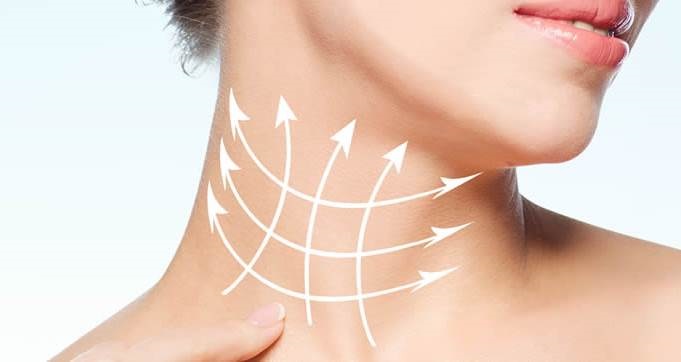
Neck lift: In the patients who do not want a mark and whose skin elasticity is not overly deformed, after the liposuction procedure, with the help of the special threads, the neck skin is hung like a hammock through short cuts under the ear. In this process, oil injections and jaw tip prosthesis applications can be added. Neck liposuction and lift operations can be performed under local anesthesia and suspension. Face and neck lift surgeries are performed in the surgery room under general anesthesia or under heavy sedatives (sedation). Liposuction and neck lift procedures are painless. After face and neck stretching, patients complain of tension and pressure feelings rather than pain. This goes on in a few days. These procedures are generally painless. After the liposuction of the neck and neck lift, operated areas heal fast. A bandage is usually applied to the neck and this should last for 3 days. Patients can return home on the same day. They can bathe unless they make their neck wet in the same day. There will be swelling and bruises after face and neck stretching. The bruising and swelling will usually occur within a week. Neck massage is recommended for faster recovery of the neck skin for the next 2 months. After face and neck stretching, patients are kept in the hospital for 1 night. The next day, patients are discharged. The swelling and bruise are greatly reduced within a week. Stitches are taken after six days. The patient can take a bath 48 hours after surgery. Swelling and bruises may take 20 days to fade away. However, the full fit and final shape of the face may be seen in three months depending on the thickness of the skin and the treatment. As with all facial surgeries, the patient must protect himself / herself from direct sun for three months after lower facial rejuvenation procedures.
One of the most feared problems after stretching face and neck is wound healing difficulties and skin loss. This problem can be encountered in patients with postoperative bleeding and smokers, especially when stretching is excessive. Therefore, smoking should be quit at least three weeks in advance. After the surgery, the aging process continues and there is some loosening and sagging in the stretched areas. However, this never returns to the pre-operative state. The permanence of the operation varies according to the technique used and the characteristics of the patient. In patients with thick and oily skin, sagging is seen earlier.